



What Size Door Threshold Strip Do I Need?

What Size Door Threshold Strip Do I Need?
Choosing the correct door threshold strip size is important for creating a clean, secure transition between floors. A threshold that is too narrow may not fully cover the gap between floors, while one that is too wide can look oversized and may not sit properly in the doorway.
The correct size depends on several factors, including the width of the doorway gap, the type of flooring, and the height difference between floors.
This guide explains how to measure your doorway and choose the right threshold size for a professional finish.
Why Threshold Size Matters
A door threshold strip is designed to cover the join between two floors and protect the exposed edges of flooring materials.
Choosing the correct size ensures that the strip:
-
Properly covers the expansion gap
-
Protects the edges of flooring
-
Creates a neat transition between rooms
-
Sits securely without movement
-
Looks balanced within the doorway
If the threshold strip is too small, the flooring edges may remain visible or unprotected.
Measure the Gap Between Floors
Before choosing a threshold strip, you should measure the gap between the two floors in the doorway.
Most floating floors such as laminate or engineered wood require an expansion gap of around 8–10 mm on each side of the doorway.
This means the total gap between floors is often around:
16–20 mm
A threshold strip needs to be wide enough to comfortably cover this gap while overlapping both flooring edges.
Common Door Threshold Strip Widths
Threshold strips are available in several standard widths. The most common sizes include:
| Threshold Width | Typical Use |
|---|---|
| 40 mm | Small expansion gaps or narrow joins or uneven floors |
| 40 mm | Standard doorway transitions or uneven floors |
| 50 mm | Larger gaps between floors or uneven floors |
| 60 mm+ | Wide joins |
For most residential doorways, a 40 mm threshold strip provides good coverage and a balanced appearance.
For when a Larger gap is required to be filled 50mm Threshold Strips can be used.
Choosing the Right Size for Different Floor Types
Different flooring combinations may require slightly different threshold widths.
Laminate to Laminate
If laminate flooring is installed in both rooms, a threshold strip simply needs to cover the expansion gap between the floors.
In most cases:
40 mm thresholds work well for laminate joins.
Laminate to Tile or Stone
Tile and stone floors can sometimes sit slightly higher than laminate flooring. A slightly wider threshold strip can help bridge the transition more effectively.
Common choice:
40–50 mm threshold strips
Laminate to Carpet
Carpet transitions often require a little more coverage because the carpet edge and gripper rods need to be concealed.
Typical sizes:
40–50 mm threshold strips
Laminate to Vinyl
Vinyl flooring is usually thinner than laminate flooring. A standard width threshold strip usually provides enough coverage.
Typical size:
40 mm threshold strips
Wood to Carpet
Wood flooring and carpet transitions often benefit from slightly wider thresholds to properly cover the carpet edge.
Common size:
40–50 mm thresholds
Consider the Height Difference Between Floors
Threshold width is important, but you should also consider floor height differences.
If one floor is higher than the other, you may need a threshold profile designed to bridge that difference.
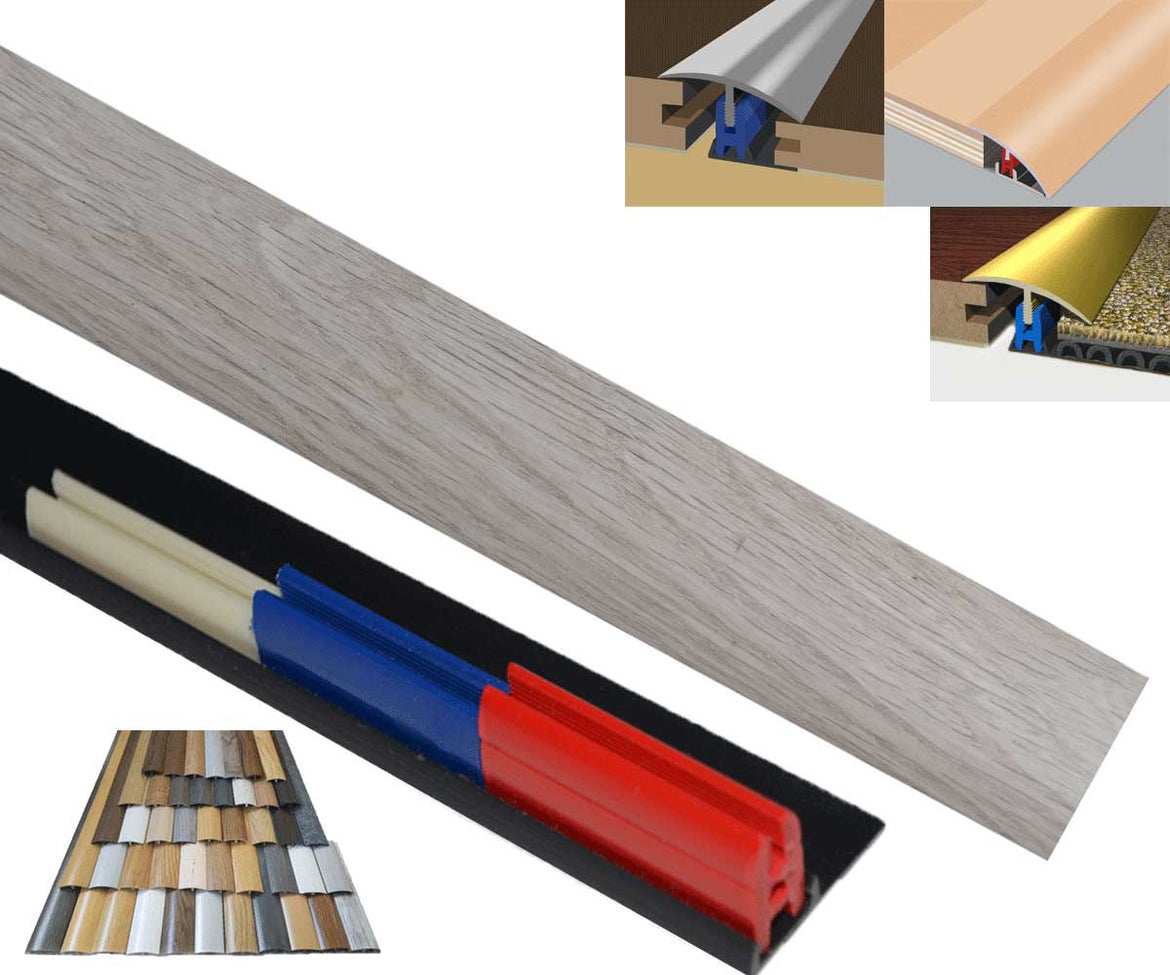
Many modern threshold systems, such as clip-in profiles, can accommodate small height variations while still providing a clean finish. Easyclip thresholds are designed to accomadate smaller and bigger height variations, They are simply the best multi purpose transitional threshold available.
You may like to see A Guide to Easyclip Thresholds Strips and Their Uses.
Measuring the Doorway Correctly
To ensure the threshold strip fits properly:
-
Measure the width of the doorway from one side of the frame to the other
-
Measure the gap between the floors
-
Check the height difference between the flooring materials
Threshold strips can normally be cut to length using a fine-tooth saw.
See Installation Guide for Multi-Purpose Thresholds
When a Wider Threshold Strip Is Better
In some situations, choosing a slightly wider threshold strip can improve the finish.
This may be useful when:
-
The expansion gap is larger than expected
-
Flooring edges are slightly uneven
-
The join between floors is not perfectly straight
-
Carpet edges need to be fully covered
A wider threshold provides extra coverage and helps hide minor installation imperfections.
Final Thoughts
Choosing the right door threshold strip size ensures your flooring transition looks neat and professional while protecting the edges of your floors.
By measuring the gap between floors, considering the flooring types, and selecting a suitable width, you can ensure the threshold covers the join properly and creates a durable finish.
For most interior doorways, 40 mm threshold strips provide a reliable and versatile solution, but wider strips may be useful where larger gaps or different flooring heights are involved.
You May also want to see How To Fit A Transitional Adhesive Door Thresholds Using Easyclip System